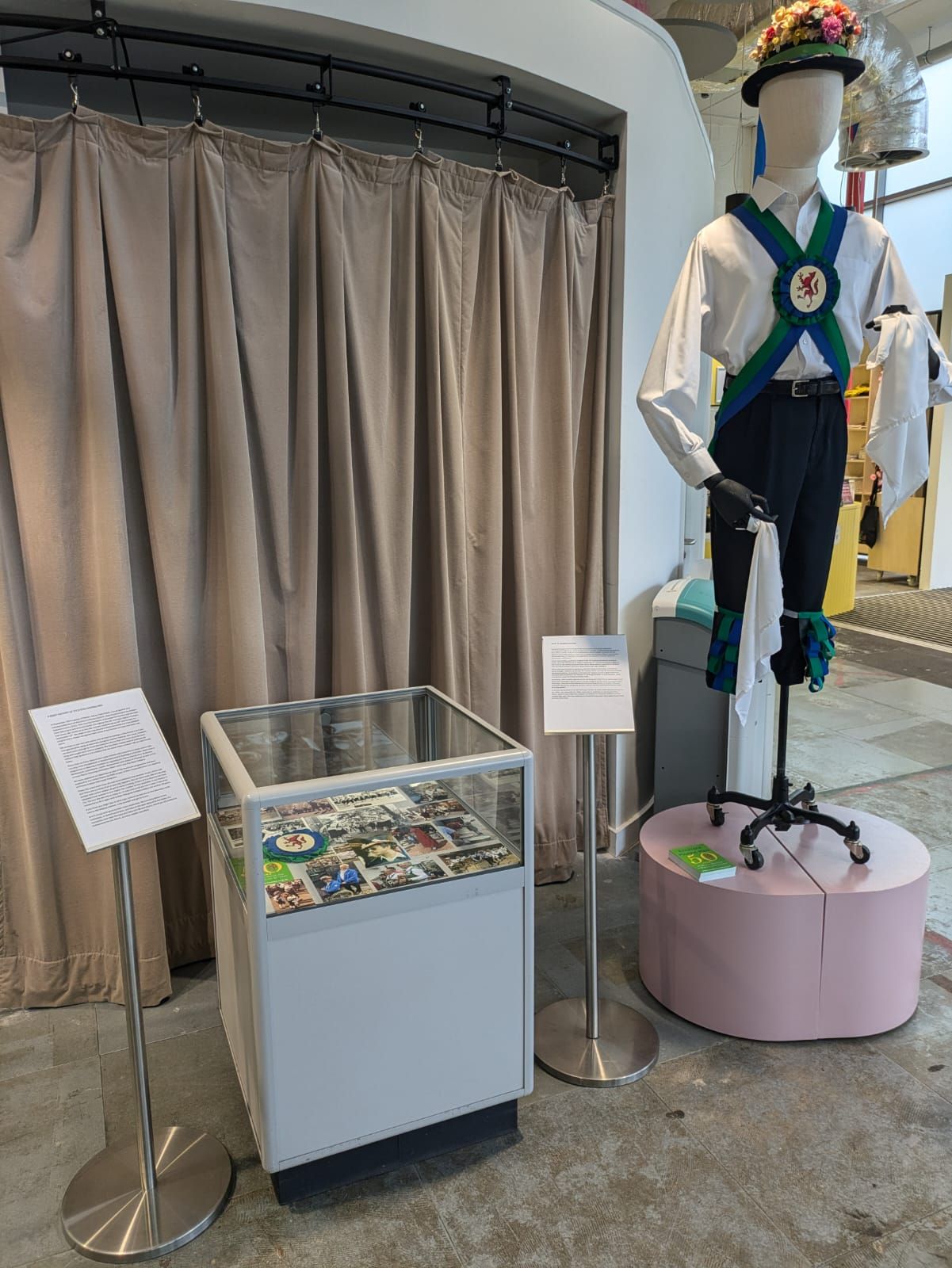
In collaboration with the Dugdale Arts Centre, Etcetera Morris Men set up a community curated exhibit with some background about the side and a display of kit and photos. The exhibit is now available to see again on the first floor of Ordnance Road Centre Library (645 Hertford Road, EN3 6ND.
50 Years of Etcetera Morris Men – Museum of Enfield
The exhibit also includes details about what Morris Dancing is:
Morris Dancing is a form of English folk dance based on rhythmic stepping in choreographed figures by a group of dancers in costume, usually wearing bell pads on their shins or shoes. They are accompanied by a band or single musician, and the dancers use handkerchiefs or sticks. It is possible that the term “Morris” comes from the Flemish form of “Moorish”, although Morris dancing has no known historical connection to the Moors.
Morris dancing first appeared in England in the 15th century and almost nothing is known about the folk dances of England before the 17th century, but by the middle of that century, the working peasantry took part in Morris dances, especially at Whitsun (late May Bank Holiday), and each village had its own style (tradition).
Morris dancing continued in popularity until the Industrial Revolution and all of its social changes. However, by the late 19th century, Morris dancing had declined and was becoming forgotten. Fortunately, in the early 20th century, several English folklorists recorded what remained in the memory of surviving members of each tradition. Chief among them were Cecil Sharp and Mary Neal.
Boxing Day 1899 is widely regarded as the starting point of the Morris revival when Cecil Sharp saw Headington Quarry dance and was intrigued by the music. He was joined by Mary Neal, a founder of the Esperance Club for working women in London. And so, the first revival performances were by young women.
In the first few decades of the 20th century a number of men’s sides were formed and in the 1950s, and especially the 1960s, there was an explosion of new dance teams – men’s, women’s and mixed who adopted or adapted the historical traditions or even created their own. That has continued to the present day when many sides of each kind are now performing.
 Etcetera Morris Men